.png)
Sales Skills Assessment: 10 Tools Every HR and L&D Leader Should Know
Most assessment tools only capture fragments of the full picture. Some measure knowledge. Some look at tendencies. Others try to observe behaviour from afar. Very few show you how someone actually performs when the pressure hits.
Evaluating sales talent has always been tricky. Sales isn’t a job where you can score someone with a neat multiple-choice test or a personality label. Real ability shows up in messy, high-pressure conversations with real buyers. That’s where logic, confidence, and emotional control collide.
Most assessment tools only capture fragments of the full picture. Some measure knowledge. Some look at tendencies. Others try to observe behaviour from afar. Very few show you how someone actually performs when the pressure hits.
This guide breaks down ten of the methods companies rely on today-from classic interviews to the new wave of simulation tech. No inflated promises. Just a clear take on what each tool does well, where it falls short, and what’s changing in the market.
Why sales skills are so hard to measure
Sales performance shifts depending on context. A rep who thrives with a technical buyer might fall apart with a skeptical one. Someone who’s charming in small talk can still forget to ask a single discovery question. And strong product knowledge doesn’t automatically translate into structured selling.
KPIs or gut instinct only work once a rep is already on payroll-by then the cost of a weak performer is real.
A good assessment process needs to capture both sides of the job:
- hard skills: logic, product depth, process
- soft skills: communication, adaptability, resilience, decision-making
And the hard truth: most tools only measure one side well.
1. Structured Behavioural Interview (SBI / STAR)
What it measures: past behaviour, judgement, communication style
- Strengths: consistent format, reduces interviewer bias
- Limitations: rewards storytelling, not current skill; candidates describe what they did, not how they’d perform today
- Best for: early screening and leadership roles
2. Role-Specific Sales Interview
Candidates walk through a pitch or account plan.
- Measures: clarity, structure, logical thinking
- Strengths: fast way to see mental organisation
- Limitations: still theoretical-no objections, no pressure
- Best for: understanding someone’s thinking process
3. Hard Skills Tests / Knowledge Checks
Quizzes, product tests, terminology.
- Measures: knowledge
- Strengths: objective, fast, scalable
- Limitations: zero link to real selling behaviour
- Best for: onboarding and regulated industries
4. Sales Case Studies / Written Assignments
Scenario + written plan.
- Measures: strategy, planning style
- Strengths: shows thought process
- Limitations: writing well doesn’t equal speaking well under pressure
- Best for: mid-to-senior B2B roles
5. Shadowing / Field Rides
Real calls or meetings.
- Measures: actual behaviour and reactions
- Strengths: closest to reality
- Limitations: unpredictable, expensive, impossible to scale; one day isn’t enough
- Best for: diagnosing experienced reps
6. Call Listening & Conversation Analytics
Platforms like Gong or Chorus.
- Measures: patterns, ratios, flow, objection handling
- Strengths: rich coaching data at scale
- Limitations: shows past behaviour, not future potential
- Best for: ongoing quality assurance
7. Soft Skills / EQ / DISC Assessments
Personality and style indicators.
- Measures: tendencies, preferences
- Strengths: good for team fit and development
- Limitations: weak predictor of sales results
- Best for: coaching and team building
8. 360° Feedback
Manager, peer, cross-team reviews.
- Measures: maturity, collaboration
- Strengths: rounded perspective
- Limitations: heavily influenced by internal relationships
- Best for: leadership tracks
9. Traditional Human Role-Play
Still powerful when done well.
- Measures: live handling of pressure, objections, adaptability
-Strengths: very close to real selling
- Limitations: inconsistent, draining, hard to scale; few reps get enough repetitions
- Best for: high-stakes hiring
10. Modern AI-Driven Sales Simulation
The new, scalable version of role-play.
Measures:
argumentation, discovery, reaction time, stress response, structure, clarity, empathy, overall execution
Strengths: consistent, objective, available anytime
Limitations: depends on strong buyer modelling
Best for: large-scale screening, readiness checks, continuous practice
Simulation platforms have grown dramatically in realism over the past two years. They now mirror buyer pushback, score behaviour with precision, and deliver detailed reports. Teams can run dozens of scenarios without trainers, meetings, or coordination.
Cost drops. Bias drops. Quality goes up.
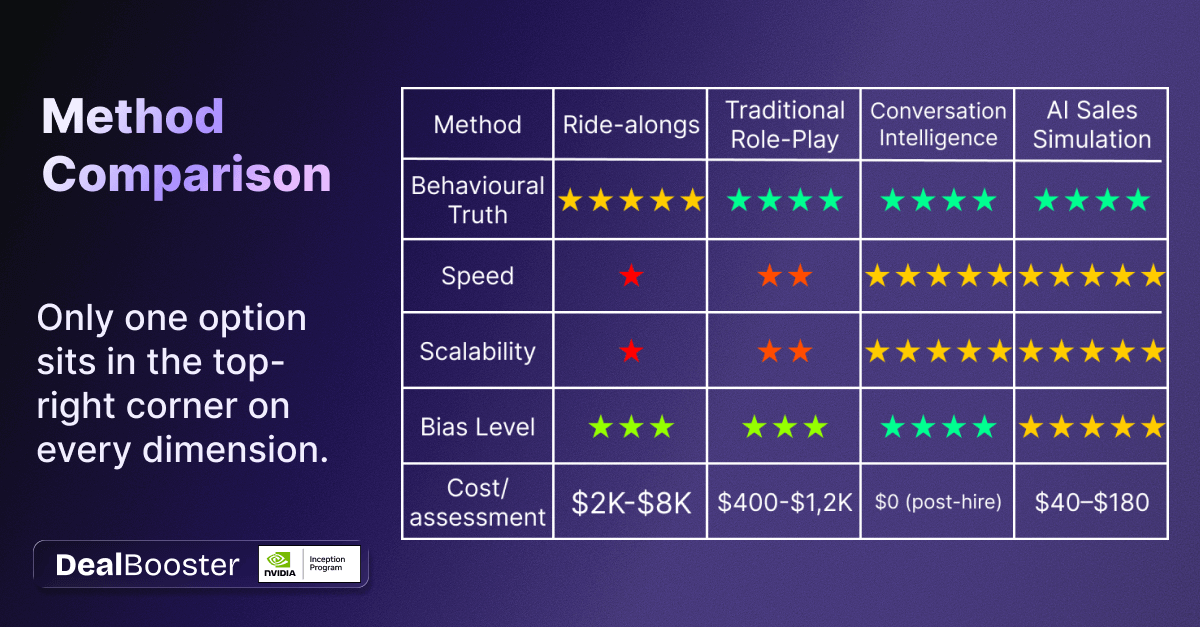
Only simulation consistently ranks at the top across all three dimensions.
Building a smart assessment process
There’s no perfect tool. Strong systems usually combine:
- a structured interview
- a knowledge check
- one real behavioural evaluation (role-play or simulation)
- ongoing call analytics
That behavioural step is where the truth shows up. It’s the only moment where you see how a rep actually sells, not how they talk about selling.
Simulation makes that part scalable without draining managers or trainers.
Where the market is heading
Over the past year and a half, the shift has been clear: companies are moving from lecture-heavy evaluation to behaviour-first evaluation. Behaviour simply predicts sales outcomes better than knowledge or personality.
Modern simulation now lets teams test reps in real conversations with almost zero operational overhead.
DealBooster is one of the players in this space - an AI environment built for live dialogue, structured scoring, and instant feedback. But the broader trend matters more than any single product. The industry finally has a consistent, scalable, objective way to evaluate how people sell.