B2B Sales in 2026: Why Traditional Enablement Is Breaking, and AI Is Making the Gap Visible
What enterprise sales leaders are missing about performance, behaviour, and readiness in complex B2B deals

The paradox of B2B sales heading into 2026
By almost every external measure, B2B sales teams entering 2026 should be performing better than ever.
They have more data.
More content.
More automation.
More AI-powered tools embedded into CRM, forecasting, outreach, and enablement.
And yet, for most enterprise teams, the reality looks very different.
Sales cycles continue to stretch.
Buying committees keep expanding.
Deals stall later, die quieter, and take longer to diagnose.
The issue has shifted away from access to information or tooling.
Execution inside complex, high-pressure deals now defines success.
In 2026, B2B sales depend less on knowledge and more on behaviour.
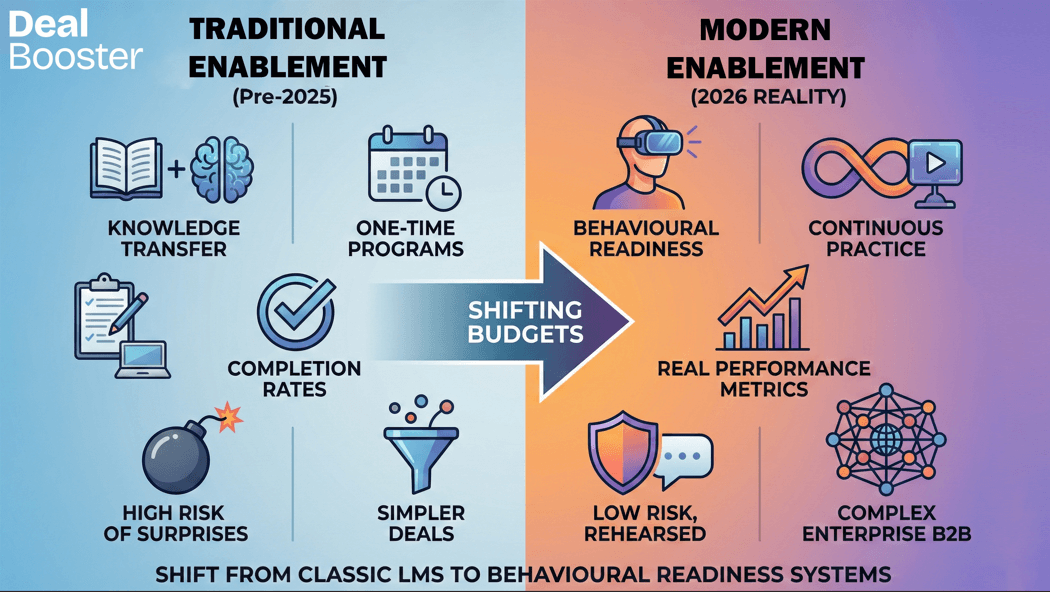
What traditional sales enablement was built for — and why it’s breaking now
Classic sales enablement models were designed for a simpler market.
They assumed a relatively linear buying journey, a limited number of decision-makers, predictable objections, and sellers who primarily needed product knowledge and messaging consistency.
This led to a focus on playbooks, onboarding programs, certifications, LMS-driven content delivery, and scripted talk tracks.
That approach succeeded when deals stayed straightforward and roles remained clear.
It struggles in modern enterprise sales.
In 2026, sellers must navigate 6–10+ stakeholders with conflicting priorities, political risk inside buying organizations, fragmented decision authority, legal, security, procurement, and finance layers, and buyers who arrive better informed but more risk-averse than ever.
Content consumption alone fails to prepare sellers for these dynamics.
The real shift in enterprise sales: from knowledge to behaviour
Most enterprise sales leaders face the same frustrating pattern.
Their teams know what to do.
But they don’t consistently deliver when it matters.
Sellers understand MEDDICC or similar frameworks, can explain value propositions in theory, pass onboarding and certification programs, and score well on knowledge tests.
They still lose control of multi-threaded conversations, mishandle objections across different roles, fail to support internal champions, default to generic messaging under pressure, or freeze when deals become politically complex.
These gaps stem from behaviour, not knowledge.
Behaviour improves through practice, not content, slides, or lectures.
Why AI is not fixing sales — but exposing the gap
AI often appears as the answer to modern sales complexity.
It accelerates research, outreach, follow-ups, forecasting, and pipeline visibility.
When administrative work fades, human execution stands out: how sellers think on their feet, handle pressure, adapt messaging by role, recover from resistance, and manage ambiguity.
AI highlights the divide between strong and weak performers.
It equips teams without replacing the need for readiness.
The skills enterprise sellers actually need in 2026
As B2B sales evolves, high-performing sellers rely on abilities to navigate multiple stakeholders simultaneously, handle conflicting incentives between IT, Finance, Legal, and Procurement, maintain structure and clarity under pressure, adjust framing and language by role, support a champion navigating internal politics, and stay calm and decisive when deals slow down.
These skills surface in live, dynamic interactions.
Traditional enablement programs rarely address them directly.
From training programs to systems of readiness
Leading organizations are rethinking sales learning.
They move toward continuous practice, systems of readiness, and behavioural benchmarking at scale.
In 2026, effective sales enablement resembles preparation more than education.
The focus ensures sellers perform when deals turn challenging.
Why sales simulations are becoming core to enterprise sales strategy
Sales simulations address how to train and assess behaviour before it impacts real deals.
They enable sellers to rehearse conversations with different stakeholder roles, conflicting priorities inside buying committees, realistic objections and stalls, and emotionally charged or ambiguous scenarios.
These tools provide repeatable conditions for practice.
Behaviour strengthens through safe, repeated exposure with feedback.
DealBooster AI Sales Coach: from enablement to readiness
DealBooster AI Sales Coach builds and measures behavioural readiness in complex B2B sales.
Through AI-driven simulations, it assesses how sellers perform, benchmarks readiness across teams and regions, identifies strengths and blind spots at scale, and accelerates development through realistic practice.
The outcome centers on execution.
What this means for enterprise sales leaders in 2026
Sales excellence comes from rehearsal.
Organizations sticking with traditional enablement will lag in closing the gap between knowledge and performance.
Those emphasizing behavioural readiness will advance with fewer late-cycle surprises and shorter timelines.
A practical next step
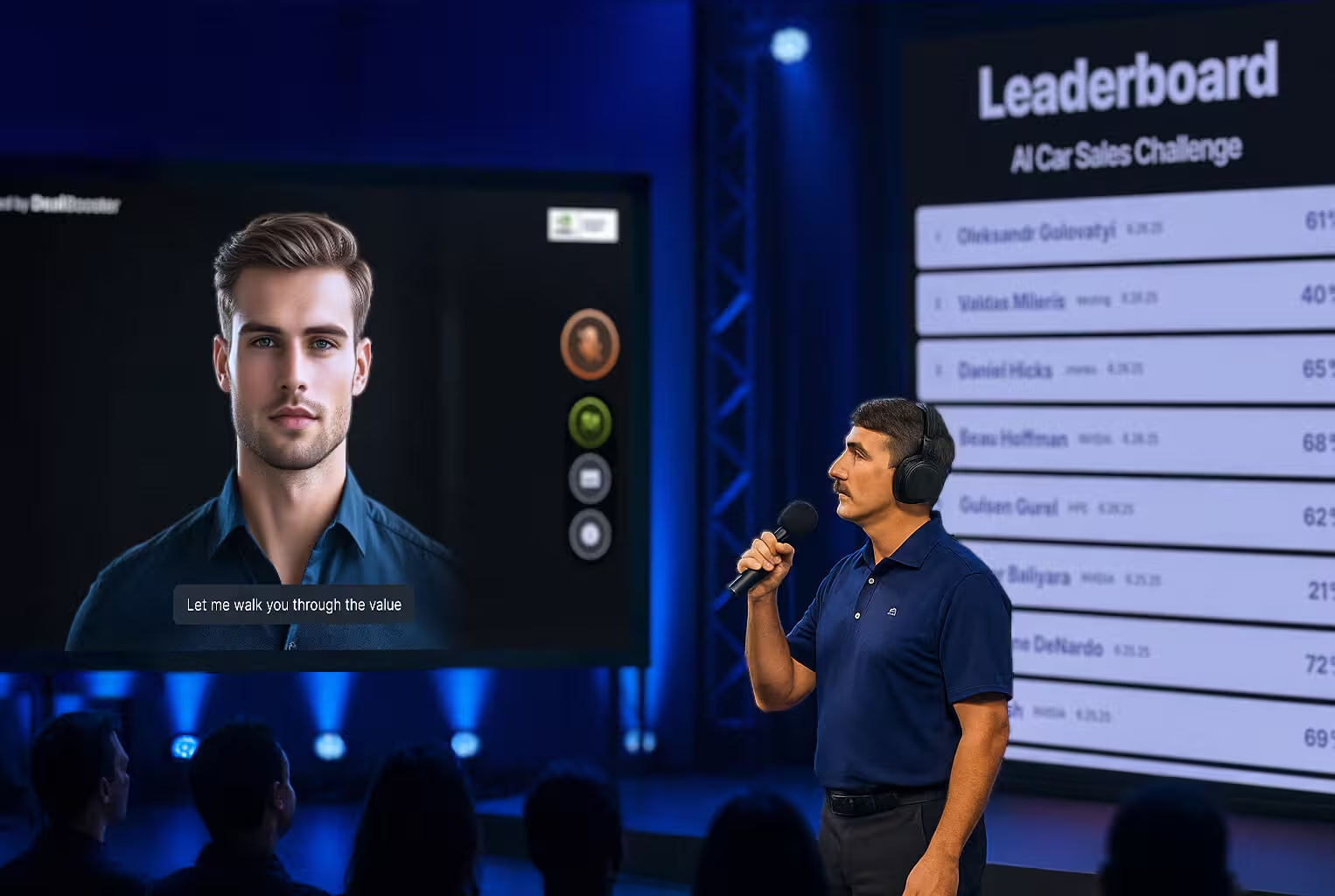
Before investing another dollar in enablement, run a $19-per-rep sales championship to reveal who on your team is ready for 2026.
For sellers, it offers a competitive challenge with rankings, scenarios, and momentum.
For sales leaders, it provides objective insight into real-world performance under pressure.
If you want to explore how behavioural readiness can be measured and developed at scale, book a demo and see DealBooster AI Sales Coach in action.
Further reading and resources
If you want to go deeper into the trends shaping enterprise sales, learning, and AI:
- B2B Sales in 2025: What Changed and What Didn’t (DealBooster Insights)
- Forrester — B2B Marketing, Sales, and Product Predictions for 2026
- McKinsey — The Changing Nature of B2B Buying Committees
- Harvard Business Review — How Buying Committees Are Reshaping Enterprise Sales
- Deloitte Insights — Enterprise AI and the Future of Work
FAQ: B2B Sales Enablement in 2026
Q1: Why are traditional sales enablement programs failing in 2026?
A: They were built for simpler, more linear deals with fewer stakeholders. Today’s enterprise sales involve 6–10+ decision-makers with conflicting priorities, asynchronous decisions, and high political risk. Content and playbooks alone don’t prepare sellers for real-time execution under pressure.
Q2: How is AI changing sales enablement?
A: AI removes administrative drag — research, outreach, forecasting — and makes performance gaps painfully obvious. When prep work vanishes, what remains is how well (or poorly) sellers actually behave in live, high-stakes conversations. AI exposes readiness, it doesn’t create it.
Q3: What’s the biggest skill gap for enterprise sellers entering 2026?
A: Behavioural readiness. Sellers know frameworks, value props, and objections in theory. They struggle to maintain structure in multi-threaded talks, adapt messaging instantly by role, coach champions through internal politics, or stay composed when deals stall unexpectedly.
Q4: How do sales simulations differ from traditional role-play or training?
A: Simulations create repeatable, realistic pressure in AI-driven environments — not one-off classroom exercises. Sellers rehearse full multi-stakeholder scenarios (conflicting priorities, tough objections, silence) with instant feedback, building muscle memory safely before it costs real deals.
Q5: What’s the fastest way for a sales leader to test behavioural readiness in their team?
A: Run a low-cost sales championship (e.g., $19 per rep) using modern simulation tools. It gives sellers a competitive, engaging experience while delivering objective data on who can actually perform under pressure — far more accurate than quiz scores or certification completion rates.